We are rebuilding our website, and a full English version is part of that work. For now, we have summarised the most important things on this page.
Why organisations choose us
We sell no software, we take no commission and we build nothing ourselves. That is why we can also advise you to keep the system you have, or to wait a while longer. What you get is an outside view with no ulterior motive.
You do not have to explain to us what a tax receipt for donations is, or how your grants shape your reporting. Our people have processed donations themselves, coordinated volunteers, and run non-profits. So we can think along with you from day one.
A report in a drawer, or a tool nobody ends up using, is worth nothing to you. We always look at what your organisation can carry, at your people and at the situation you are in, so that the digital side fits it.
They already made their digital leap
A selection of the organisations we work with.
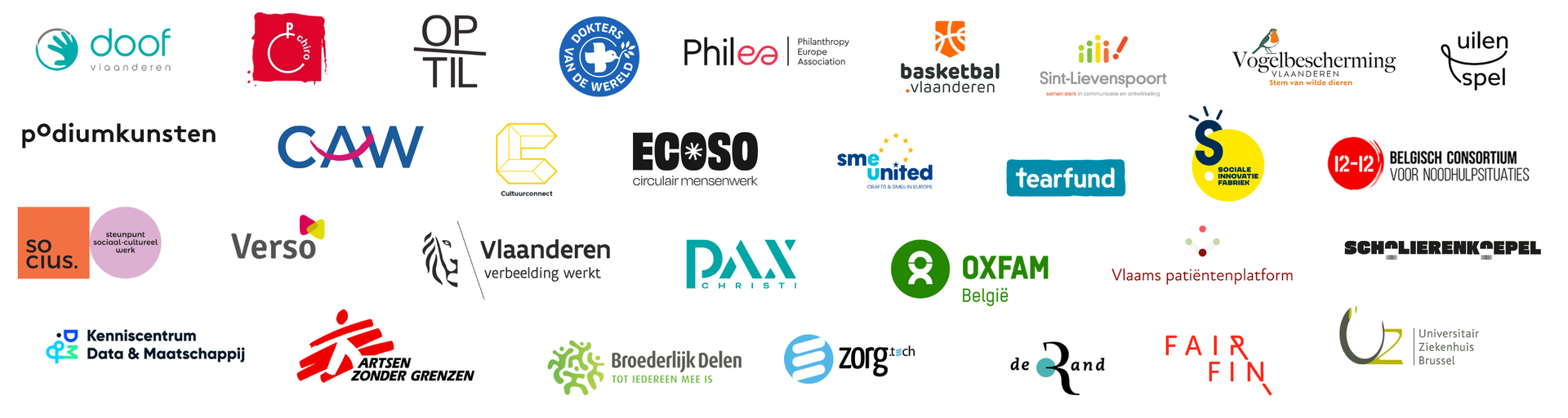
From a national youth movement with thousands of members to a charity shop chain with several branches. From a care network operating across regions to an NGO with thousands of donors. And from a European federation with members in thirty countries to a local support centre with six people in the office.
Together we made a digital leap, so that more time and energy goes to the mission.
"During the demo, the salesperson showed how their software supported speech-to-text. But after a few pointed questions from Enter Digital, it turned out he was simply using the voice recorder on his phone. We would never have noticed. I was really glad he was there."

"Everyone was experimenting with AI, but without direction. Now we have structure, and first applications that genuinely move us forward."

"A fresh and experienced outside view quickly surfaced where existing processes had grown organically over the years. And it did not stop at surfacing them: there is now a CRM process that we estimate saves 75% of the working time."

"What surprised me was how many colleagues, including the ones who were sceptical at first, started sharing ideas. The project really grew from within, at our own pace."

"At last we had someone who could hold on to the bigger picture. That brought calm, and it let us decide faster and with more confidence"

"Rutger combines transparent communication with sharp thinking on the substance. The collaboration ran smoothly and efficiently, with clear added value. We are looking forward to working together again in the future."

We work exclusively for organisations with a social mission
And that is a deliberate choice. Every sector has its own needs, its own vocabulary and its own obligations.
What they share is that those needs always come back to the same thing: the digital foundation the work runs on.
Care and welfare
The client or the patient comes first, and the case record is the backbone of the digital operation. Everything else hangs off it: sensitive data, access rights and professional confidentiality. And it has to stay workable for people who are already stretched, on site as well as at a desk.
Socio-cultural work
A broad sector, and the data reflects that. It is about members, volunteers and people taking part in activities, usually all three at once. On top of that come local branches, each with their own autonomy and their own lists.
Charities and NGOs
Here it starts with the campaign: showing the work that is being done, and moving people. What follows is what the system is for. Donors, gifts, tax receipts that have to go out on time, and legacies that need years of follow-up.
Social economy
A lot comes together here at once. Planning, the deployment of people and resources, across several sites, in an operation that cannot stand still. And alongside that the reporting, because grants require every euro to be accounted for.
Umbrella bodies, federations and funds
A different dynamic, because there is little you can impose from above. Members make their own choices, while something still has to be said about the sector as a whole. That makes aggregated data a question in its own right.
Any other organisation
From education and research to public services and social enterprises. The vocabulary differs, the question stays the same: how does the digital side increase social value, instead of making the work heavier.
What can we help you with?
Digital projects run in three phases, and we are here to help you, wherever you are in them.
Analysis and strategy
You want an overview and a clear digital direction
We map how you work today and where it pinches, whether that is about one system or about your entire operation. You get a view of the choices coming your way and of what to tackle first.
Selection and decision
You want to choose the right software and supplier
We translate the way you work into requirements, map the market and guide the demos together with the people who will use the system. At the negotiating table we watch the agreements on scope, cost and responsibilities.
Guidance during implementation
You want to carry out your plans and keep the project moving
We watch the bridge between the technology and your organisation, and keep an eye on whether your people are coming along. Throughout the project we make sure you genuinely understand what the supplier means.
How much support do you need?
that is entirely your choice
you do most of the work
we do most of the work
As a sounding board
We look over your shoulder at the moments that matter and ask the critical questions.
Working it out together
We take on parts of the work, you take the rest, and we make sure you are always up to speed.
Taking work off your hands
We take on the programme management, or one clearly defined piece in full.
Who you will be working with
We work with senior profiles only, and they have all stood on both sides of the table. They have built software themselves, led implementations or drawn up architecture. And they know the sector from the inside, because they have worked in it. That is what lets them translate between the technology and your organisation.
You get one fixed point of contact, from start to finish. Behind the scenes we work with an internal sounding board, so that what you get is sound and stays independent. And we always say it in a warm and human way, because we know how much that matters in this sector.
What does that guidance look like in practice?
Three projects that show how different guidance can look: from a European public tender for an entire network to a platform the team ended up building themselves. Click through for the full story.
CAW Groep · Care and welfare
From need to decision: one client record system for an entire network
A network of autonomous regions that had to choose one system together, through a European public tender.
We translated the way they work into requirements, guided the assessment of the tenders, and made sure the choice kept matching what the social workers actually needed.
Chirojeugd Vlaanderen · Socio-cultural work
Bringing order to a complex CRM implementation
Thousands of members, local groups keeping their own records, and a national office that has to keep sight of the whole.
We guided the implementation of the new system. We brought teams, processes and technology back into line, within a tight deadline.
Vivo social profit · Umbrella bodies and funds
A platform the team built themselves within three months
The experience from more than 150 support projects had to come together in an online platform, with a tight deadline and experts who were only available now and then.
We used AI to bring structure to the material quickly and guided the co-creation. The team built the platform themselves, without outside IT help.
What is on your mind?
We are happy to take a look. It costs you nothing and commits you to nothing. And if we turn out not to be the right fit, that is no problem at all.
Do not put it off any longer. Send us a message,
or feel free to call +32 485 79 76 62.
How digital is the non-profit sector?
We measure that every year in the Digitale Barometer, an independent study of Belgian non-profits together with AP University of Applied Sciences and Arts Antwerp. Organisations that take part see straight away where they stand.
Frequently asked questions
Are you an IT partner, an ICT agency or a software vendor?
None of the three. We are an independent consultancy for digital choices in the social profit sector. We sell no software, we develop nothing, we do not configure your system and we do not manage your IT. What we do is the advice and the guidance around it: working out what you need, underpinning the choice and watching over the execution. Within that we take on agreed analysis, coordination and preparation work, such as cleaning up your data or the programme management of a roll-out. So your ICT partner and your software vendor keep doing what they do. We sit on your side of the table.
What is the difference between you and our IT partner?
An IT partner or IT service provider takes care of the day-to-day: that your Microsoft 365 or Google Workspace runs, that Teams and SharePoint work, that Outlook and your devices do what they should, and that the permissions are set correctly. We do not do that, and that is deliberate. We look one level higher: why your documents are where they are, which structure makes sense for what you want to keep and share, and who needs access to what. If you are stuck on document management, we draw up the architecture for your SharePoint or your Google Drive together with you, including the folder structure and the agreements on sharing. The execution is done by you, or by your service provider. For a question about Teams or about the permissions themselves, you are better off with them.
Do you help with choosing a CRM or an ERP?
Yes. Software selection is the question we get most often. We notice that names such as Odoo, Afas and Salesforce are becoming better known in the non-profit sector too, and they prompt a lot of questions. There is also software made for our sector, such as Procurios or Eudonet, and organisations sometimes run into its limits and want to know whether there is something better. And a lot of custom-built software is still running, with the question of how to migrate away from it. CRM and ERP are umbrella terms: what you really need differs per sector and per organisation, and sometimes it is actually about something else. That is why we start from what is needed, and we challenge that too. Only then do we look at the market: what fits what you already have, what you do today and want tomorrow, your requirements and your budget.
We already work with a supplier. Is this still useful?
Yes, and often precisely then. A supplier advises on their own offering, and that is entirely fair. We look at your operation as a whole and at what you will need five years from now. In practice we find that a software vendor is glad to have us as a guiding partner. We are not there to rap anyone on the knuckles, but to translate in both directions: we explain what the supplier could not get across, and the supplier can test things with us that they cannot ask the client directly. That way we lift the project to a higher level together, and everyone benefits.
Our digital project has stalled. Can you still put it right?
Often, yes. We always talk to the supplier respectfully, because we speak their language and we understand their side. We deliberately show both sides, and it usually turns out that a lot has simply remained unclear. Once that is cleared up, you can as a rule continue with the same supplier, although each side has usually had to give a little. After that we look at what is needed to make it work again, and not only at the technology but also at the people. It helps that we do this often and you perhaps once: if you get three different project leads in one year, you do not know whether that is normal. We do, and we can hold a supplier to account for it.
How do we know where our organisation stands digitally?
That is usually where a project starts. We carry out a digital baseline assessment: we map your application landscape, look at how you work today and where it pinches, and compare that with what similar organisations do. That gives a picture of your digital maturity, and a multi-year plan with what to tackle first. For a smaller organisation, a review of a few days is often enough to know what has to happen first.
What does a project with Enter Digital cost?
That depends on two things: how broad your question is, and how much you take on yourself. The smallest form is a short check or a focused audit of a few days. A selection project or a strategy runs over several months, although that is elapsed time and not full-time effort. We always start with a half-hour conversation, with no obligation. If we can help, you get a proposal with the scope, the approach and the price in it.
How much of our own team's time does this take?
We agree that up front. In a sounding-board project your own team does most of the work and we look in at the moments that matter. If we take on more, your input is still needed to make choices, test proposals and bring your colleagues along. One thing you can never outsource: the time of the people who will actually use the system. Without their input you are choosing a system for someone else.
Do you do IT governance, or act as an external CIO?
Partly. We do not take on a permanent role as external CIO or IT manager, because we would gradually become the decision-maker ourselves. What we do is help put the IT governance around it in place: who decides what, how you follow up your suppliers, and how you prevent shadow IT from springing up again next to the systems you already have. If an IT audit or a multi-year programme is under way, we can help watch over it without taking over your IT.
What is the difference between digitisation, digital strategy, digital transformation and IT strategy?
Digitisation is turning what you do on paper into a system. An IT strategy is about your systems and your infrastructure: what you run and how it fits together. A digital strategy is broader and starts from your operation: which direction you take, in what order and why. Digital transformation is what happens when those choices also change the way you work, and that is the part where it usually goes wrong. We start with the strategy, because without that order you buy software for a problem you have not yet pinned down.
Our organisation is small. Can we come to you?
You are welcome with a narrow question too. Our clients range from organisations with a handful of staff to hospitals and networks with hundreds of people. For a smaller organisation, a digital review of a few days is often enough to know what has to happen first, and sometimes a short check on one concrete question is all it takes. If your question does not fit what we do, we say so and point you elsewhere.
Which organisations do you work for?
For organisations with a social mission: non-profits, associations and social profit, and social enterprises where that mission is the heart of the work. Care and welfare, socio-cultural work, charities and NGOs, the social economy, umbrella bodies and funds, and alongside those education, research and public organisations. What matters is not your legal form but your purpose.